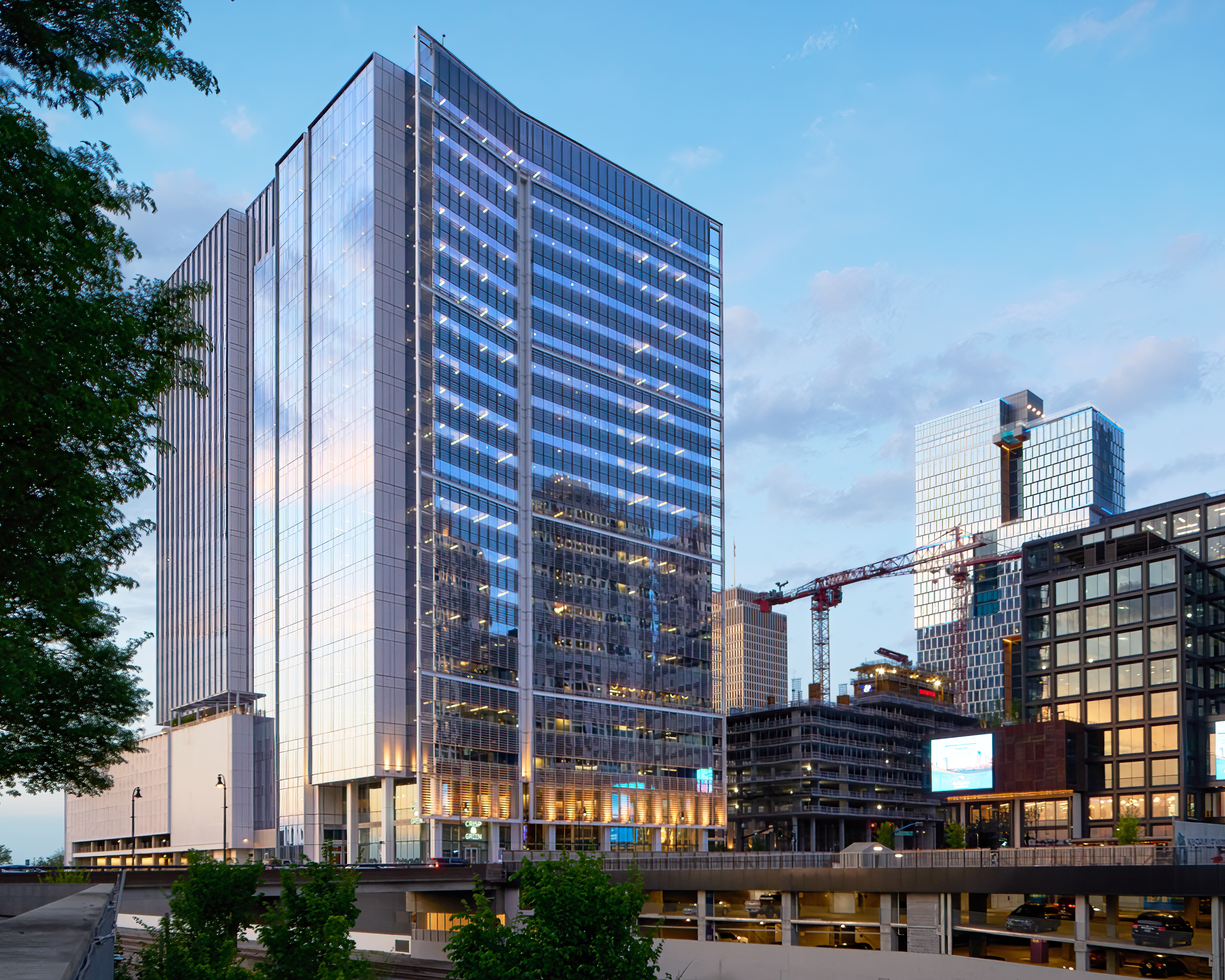
The east tower of Amazon's Operations Center of Excellence gives Nashville Yards a softer architectural edge than most modern office buildings attempt.
Amazon's two Nashville towers form the northern anchor of the Nashville Yards development. Named Anne and Juno, after figures in the women's suffrage movement, the two towers stand 20 and 28 stories respectively and together make up Amazon's Operations Center of Excellence. Anne opened first, in 2021, with Juno following as Amazon expanded its Nashville footprint past two thousand employees. What is unusual about the pair is not the size. It is the way the shorter tower handles its southern corner.
Most new office construction in the Southeast follows a rigid right-angle logic. The east Amazon tower does not. Its south corner is treated as a soft, continuous curve that runs the full height of the building. From the Demonbreun Street bridge, the curve reads as a single sweep of glass that catches the sky and throws it back in a way flat facades cannot.
The curve is not decorative. It is what gives the building its identity in a district where several similar-scale office towers are going up at once. It also creates a set of interior conditions, especially on the corner floors, that a rectangular building could not offer.
The facade reads as a tightly spaced horizontal band of glass across the entire building. The bands are broken by subtle shifts in glass tone that create a soft variation across the face. At night, the pattern is reinforced by the lighting in the ceiling plane of each floor, which makes the building's floor plates visible from a distance.
This horizontal emphasis is a deliberate counterweight to the vertical towers across the development, including the Pinnacle and the Grand Hyatt. The Amazon building is taller than it is wide, but its articulation insists on horizontal movement. On a shoot, that changes how you compose the tower. Vertical crops flatten the design. Slightly horizontal framings read more honestly.
The base of the tower meets the active CSX rail line that cuts through Nashville Yards. That rail context is impossible to ignore. The building literally hangs over the tracks, and the ground-level retail and pedestrian spaces are organized around the elevated infrastructure that crosses the site.
Shooting from the north side, the tracks become a leading line into the composition. The curve of the tower rises above the steel bridge and the rail cars in a way that grounds the building in the industrial heritage of the neighborhood. It is one of the strongest compositional moves the site offers.
The Amazon tower is a curtain-wall building, which means the facade is doing most of the visual work. Dawn and dusk are the best times to photograph it. In those hours, the sky produces the most varied color temperatures and the curved corner captures the most dynamic range of light. Overcast conditions also work, because they reduce specular reflection on the glass and let the horizontal banding read more clearly.
The trickiest part of the building is choosing how much of the adjacent west tower to include. The two buildings work as a pair, but one of them usually needs to be the subject. A good architectural photographer in Nashville makes that choice carefully and sticks to it through the shoot.
Have a project that needs to be photographed? Reach out to get the conversation started.
See more of my architectural photography work in Nashville.
If you are finishing a new build, opening a venue, or documenting a space that matters to the city, timing and approach make a difference. I work with architects, builders, and developers who want their projects photographed clearly and honestly.