The first chapter of a build is the one nobody captures, and it is the one that explains everything that comes after.
Most construction photography and videography starts once there is something recognizable to point a camera at: a frame, a facade, a room taking shape. By then the hardest part of the job is already buried. Before a building can go up, the ground has to be made to accept it, and that work has its own scale, its own equipment, and its own short window before it disappears under a slab.
This is the first of three pieces on capturing a project across its full life. It starts where the project starts, on bare ground.
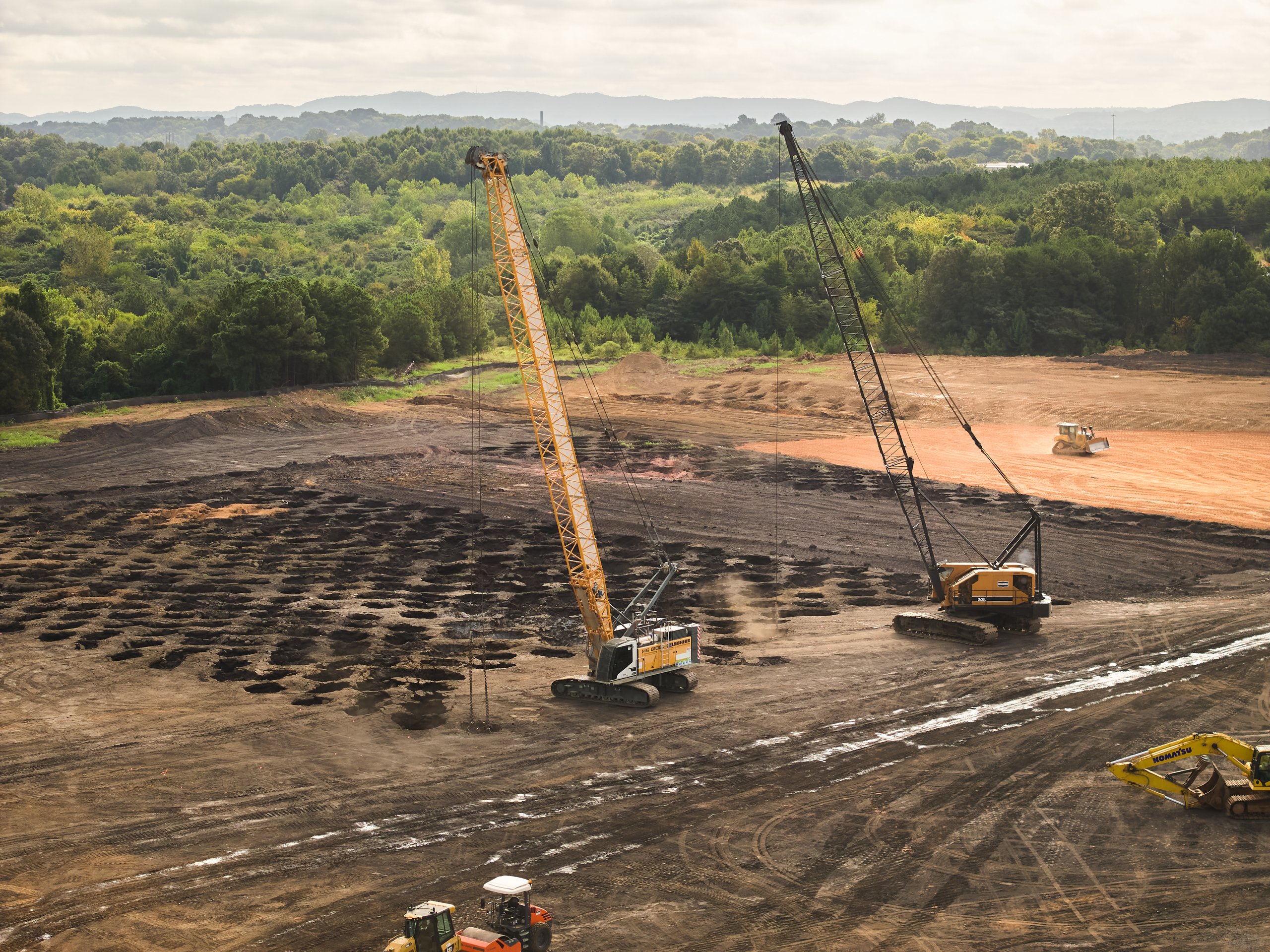
On a Cooper Construction site in Hermitage, just east of Nashville, the earliest phase was rock. Crews blasted and cut into the ledge to make a buildable pad, then graded and shaped what was left. Standing on that site, the thing you notice is that the ground is not a blank surface waiting for a building. It is the first structure, and someone had to build it.
This phase gives you things you will never get again in terms of the storytelling. Raw cut stone with the drill marks still in it. Grade stakes and string lines laying out a footprint that exists nowhere else yet. Machines working at a scale that reads clearly because nothing is enclosing them. Once the slab is poured, all of it is gone.
An open site is the only time a project is fully exposed to the sky, and that changes how I shoot it. There is no facade to bounce light, no interior to balance against a window. It is just terrain, machines, and weather.
Early and late light does most of the work here. Low sun rakes across a graded pad and makes every contour and track mark legible, where midday flattens the whole thing into a gray field. Cut rock in particular needs raking light to read as rock rather than as a smudge. I plan site-prep visits around that, the same way I plan a finished interior around when the sun clears the building next door.
Overcast days are not a loss on these shoots. Flat light suits detail work: reinforcement laid out, forms set, the geometry of a footing before it is filled.
On a residential build with Crosby Construction, the interesting frames were the structural ones, the parts of the work that get covered up permanently within days. Framing, connections, the quality of the work in places no client will ever see once the drywall is on.
That is the argument for photographing this phase at all. A builder's craft is most visible before it is finished. A homeowner sees paint. A future client, looking at a builder's portfolio, sees how the thing was actually put together. Those are different pictures and they persuade different people.
The practical problem with construction documentation is that it is not repeatable. The finished building will still be there next month. A site pad will not.
What I ask builders for is a rough schedule, not a fixed date: when does blasting finish, when does the slab pour, when does steel arrive. Then I plan visits around the transitions rather than the calendar. On the Statesboro, Georgia industrial build for Cooper Construction, the moment worth catching was the slab sitting open and complete, before steel closed it in. A week later, that view no longer existed.
Three or four short visits across a build, planned around those transitions, produce a far better set than one long day at a random point in the schedule.
Site prep is the phase clients understand least and builders work the hardest at. It is expensive, it is technical, it is weather-dependent, and it vanishes completely into the finished project. Photographing it is how a builder shows the part of the job that explains the price and the timeline.
I enjoy capturing this stage. There is nothing decorative on an open site. Everything in the frame is there because the work required it.
The Hermitage project in Nashville is the clearest example of this phase in my work, where rock blasting and grading were the whole story. Those frames are on the Hermitage project page.
If you have a project breaking ground in the Southeast and want it documented from the beginning, I would love to work with you. Reach out on the contact page
If you are finishing a new build, opening a venue, or documenting a space that matters to the city, timing and approach make a difference. I work with architects, builders, and developers who want their projects photographed clearly and honestly.