A look at one of Austin's most significant cultural buildings, and what it takes to photograph it well.
The Blanton Museum of Art sits at the southwest corner of the University of Texas campus, anchoring a block of East 23rd Street that the university has gradually transformed into a public cultural precinct. The museum opened in 2006 in two connected buildings designed by Kallmann McKinnell & Wood, a Boston firm known for civic and institutional work. The buildings are substantial, nearly 190,000 square feet total, and their scale on the UT campus is deliberate: the Blanton was designed to read as a major institution, not an annex.
For anyone working in architectural photography in Austin, the Blanton presents a layered subject. There are at least three distinct architectural moments on the grounds, each requiring a different approach.
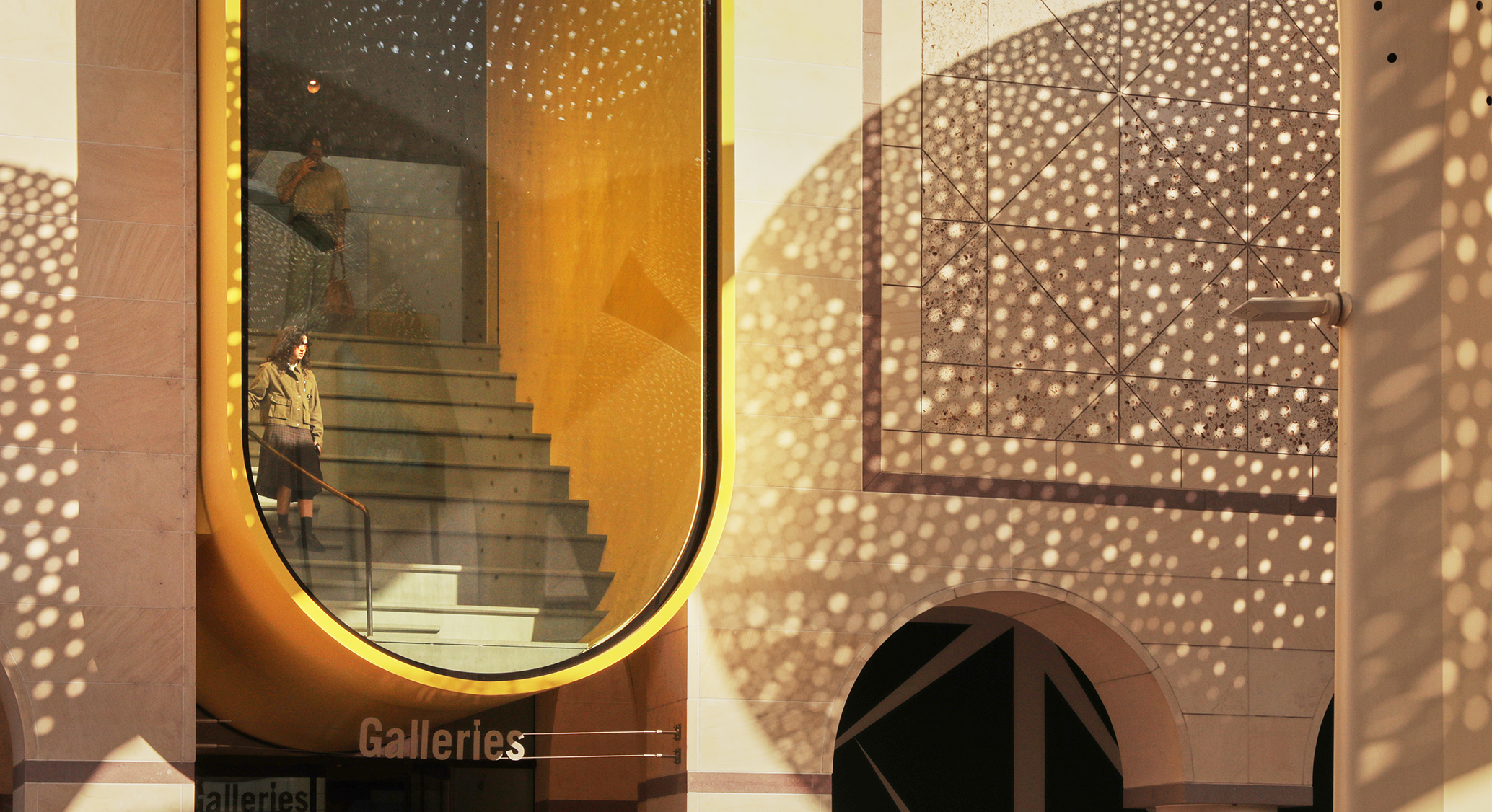
The two main Blanton buildings, the Edgar A. Smith Building and the Mari and James A. Michener Art Building, share a vocabulary of warm Texas limestone and bronze-tinted glass. The facades are composed in careful horizontal rhythms: deep-set windows, prominent cornices, and a massing that steps back from the street to create covered entry zones.
What makes the buildings productive subjects for photography is their relationship to light. The limestone reads warm in morning and afternoon sun and nearly white at midday. The glass curtain walls register the sky differently at each hour. From across the main plaza, the buildings compose cleanly against the Austin skyline or, depending on the angle, against the tree canopy of the campus interior.
The most architecturally distinctive element on the Blanton's grounds is not one of the museum buildings. It is the freestanding pavilion designed by Ellsworth Kelly, completed in 2018 and opened after the artist's death in 2015. Known simply as "Austin," the structure is built entirely of limestone, with a central skylight, colored glass windows along the upper walls, and a monolithic black marble totem at the center.
Kelly designed "Austin" as a synthesis of architecture and art, a space where the light itself is the primary experience. The building has no obvious contemporary reference points; it looks ancient and new at once. For architectural photography, it is one of the most demanding subjects in the city. The light inside changes by the hour. The geometry is simple enough to feel infinite. Getting it right requires patience and a clear understanding of what the space is designed to do.
In 2022, the landscape architecture firm Snohetta completed a redesign of the Blanton's outdoor grounds, unifying the space between the two museum buildings, the Kelly pavilion, and the surrounding campus. The project introduced new pathways, plantings, and a central plaza designed to draw visitors from the street and create a cohesive precinct out of what had been a series of disconnected spaces.
The redesigned grounds give architectural photographers something the original site lacked: a coherent exterior sequence. The relationship between the limestone buildings, the Kelly pavilion, and the oak canopy that surrounds the site is now readable as a single composition rather than a collection of separate elements.
Museums are among the most demanding architectural subjects because they are designed to be experienced, not just seen. The Blanton is no exception. The light inside is calibrated to serve the art. The exterior is composed to serve the institution. Photographing it well means understanding those priorities and finding the conditions where they are most clearly expressed.
Austin architectural photography in institutional settings requires patience and planning. The right light, the right time of day, and a real understanding of what the building is trying to accomplish are what separate a record shot from an image that actually shows the architecture.
I would love to work with you, reach out on the contact page.
See more of my architectural photography work in Austin.
If you are finishing a new build, opening a venue, or documenting a space that matters to the city, timing and approach make a difference. I work with architects, builders, and developers who want their projects photographed clearly and honestly.