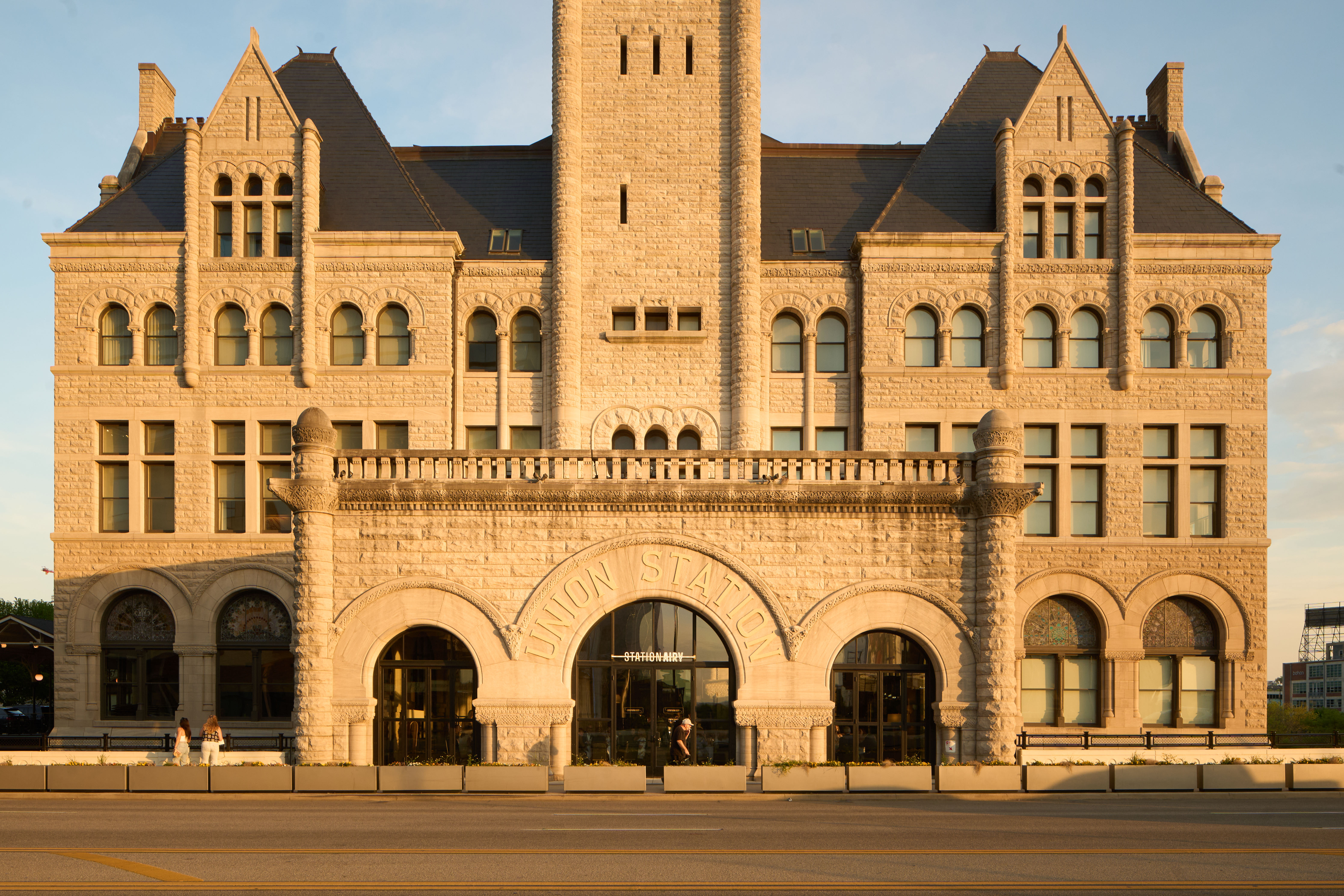
The 1900 rail terminal still anchors the western edge of downtown, now set against the new towers of Nashville Yards.
Union Station Hotel at 1001 Broadway is one of the most important pieces of historic architecture in Nashville. Built between 1898 and 1900 as the Nashville Union Station rail terminal for the Louisville and Nashville Railroad and designed by Richard Montfort, an engineer for the L&N, it served as a passenger station for almost eighty years before closing in 1979. After more than a decade of neglect, the building was restored and reopened as a hotel in 1986. The current operation continues to serve as both a working hotel and a fully preserved piece of civic architecture.
Union Station is one of the clearest examples of Richardsonian Romanesque in the Southeast. The style, named after Henry Hobson Richardson, emphasizes heavy rough-cut stone masonry, round arches, short columns, and a strong horizontal base anchored by a prominent tower. Every one of those elements is present on the Union Station facade.
The building is clad in rusticated Bowling Green gray oolitic limestone, with pink Tennessee marble used heavily inside the great hall. The main entrance is framed by a heavy round arch, the gabled roofline is punctuated by dormers, and the entire composition is organized around a roughly 220-foot clock tower capped by a figure of Mercury, the Roman god of trade and travel. The original bronze Mercury was toppled in the March 1952 tornado outbreak. A restored Mercury was returned to the tower in the late 1990s, damaged again in the 1998 tornado, and replaced in the years since, each successive statue returning the tower to something close to its original silhouette.
Union Station now sits directly across the tracks from the Nashville Yards development, which includes the Pinnacle tower, the Grand Hyatt, and the Amazon towers. The contrast between the nineteenth-century stone landmark and the twenty-first-century glass towers is one of the most compelling urban conditions in downtown Nashville.
Photographing Union Station today is as much about capturing that contrast as it is about documenting the building itself. From the Broadway bridge, both eras of architecture appear in a single frame. From the plaza at the north side of the hotel, the clock tower rises against a background of new construction. The building has become a reference point for how much Nashville has changed while still insisting on what it has preserved.
Behind the hotel, the original train shed, once one of the largest single-span structures in the world, has been reconfigured as a covered pedestrian plaza. The iron and glass structure is no longer used for trains, but the bones are still there, and the scale of the shed is unlike anything else in downtown Nashville.
For a full architectural story on Union Station, the train shed is not optional. It is part of what makes the building's preservation complete, and it often appears in images that document the hotel as a working civic space rather than simply a historic facade.
Stone buildings of this age take warm directional light well. The rusticated limestone reads almost red at sunrise and sunset, and the deep shadows in the arches and dormers give the facade a sculptural quality that modern buildings cannot match.
The busiest time of day around Union Station is also often the most photogenic. Pedestrians walking past the Broadway entrance, traffic crossing the bridge, and the reflections of light on the new towers across the rail yard all add life to the image. A good architectural photographer in Nashville treats the building as part of a living city, not as a museum piece. That is how the image stays truthful to what Union Station actually is.
Have a project that needs to be photographed? Reach out to get the conversation started.
See more of my architectural photography work in Nashville.
If you are finishing a new build, opening a venue, or documenting a space that matters to the city, timing and approach make a difference. I work with architects, builders, and developers who want their projects photographed clearly and honestly.